Learn more
Hand Block Printing in Jaipur

Jaipur is famous for its forts and palaces, but some of the Pink City's most enduring artistry is made quietly, in courtyards and homes on the edge of the city, where lengths of cotton are printed by hand and laid out to dry in the sun.
Hand block printing is one of Rajasthan's oldest crafts, still worked much as it was centuries ago and a morning spent among the printers is one of the most rewarding things you can do in Jaipur. Whether you have never held a printing block or you already know your dabu from your indigo, the craft rewards a closer look.
.webp)
A craft with deep roots
Block printing came to the Jaipur region through the Chhipa, communities of hereditary printers and dyers who have carried the skill down through families for generations. Under the patronage of the Rajput court their cloth came to be prized far beyond Rajasthan, and the name ‘Jaipuri prints’ still carries that reputation. The tradition here reaches back some four to five hundred years, shaped by the availability of water, the local dye plants, and the slow accumulation of knowledge held within printing families.
Very little of it has been mechanised and, in a world where AI and mass-production prevails, we feel that is the point, and the pleasure.
.webp)
How a block print is made
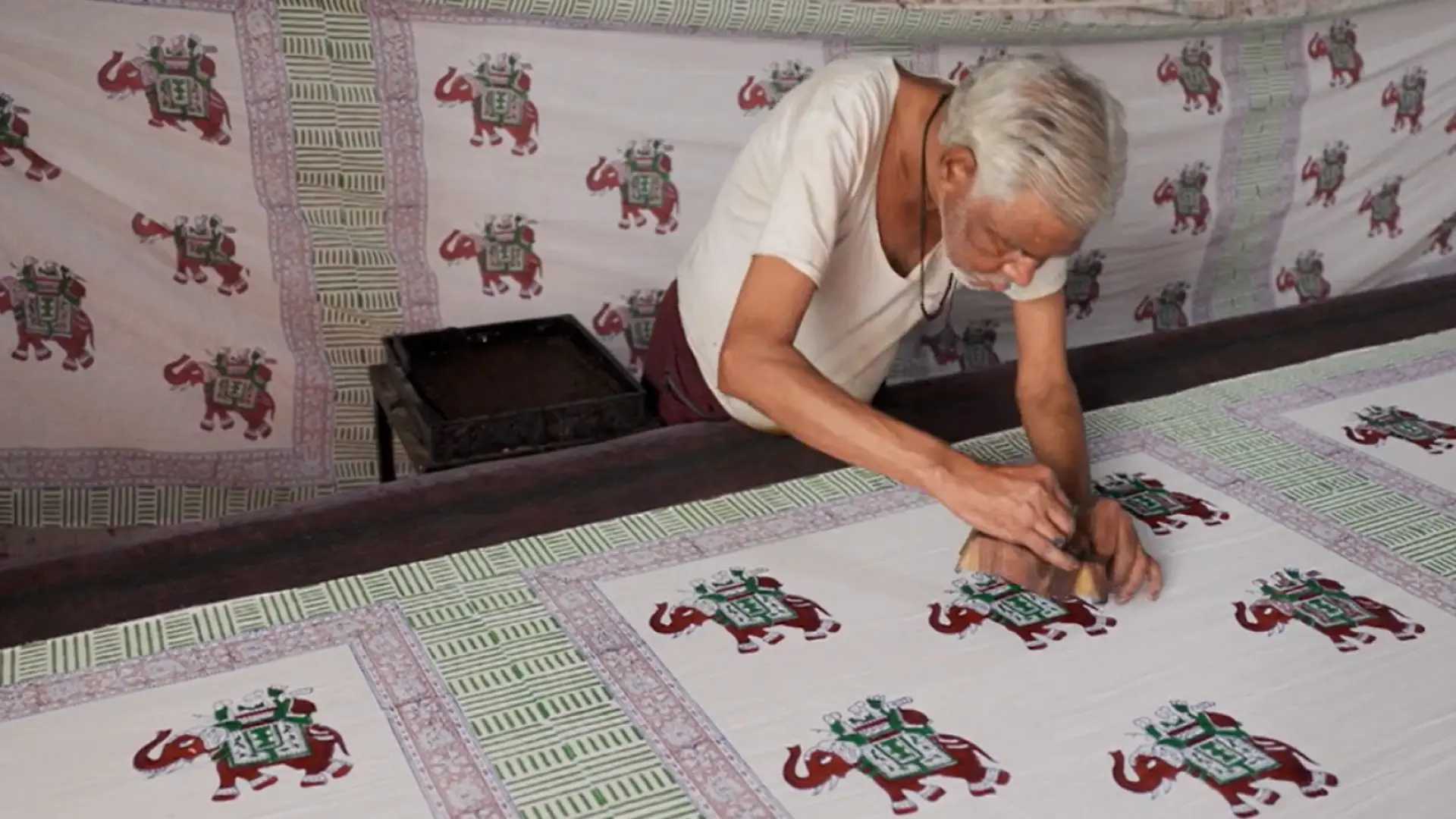
Every design begins with the block. A carver works a pattern into a piece of seasoned teak or sheesham by hand, a single block sometimes taking a day or more to finish, and the wood is then oiled to feed the grain. A finished cloth is rarely the work of one block though; the printer builds the design in layers, starting with the background, then the rekh - the fine outline block that carries most of the detail - and finally the datta, the blocks that fill the pattern in. A small mark carved into the edge of each block guides the alignment, and reading that guide by eye, press after press, is the skill that takes years to master and separates the high quality from the low quality printing.
The colour matters as much as the carving too; traditional dyes are drawn from the land: indigo for blue, madder for red, iron and turmeric for darker and golden tones. Many need weeks or months of curing before they reach their proper depth, and their final colour shifts with the water, the weather and the season, so no two batches are ever quite alike. This is also why hand block prints carry their small irregularities of alignment and depth. Far from being flaws, those slight shifts are the surest sign that a person, and not a machine, has made the cloth.
.webp)
Bagru and Sanganer: two villages, two characters
Most of the printing happens not in Jaipur itself but in the villages around it, and two names are important.
Bagru, around thirty kilometres out along the Ajmer road, is the older and more rustic of the two. Its signature is dabu, a mud-resist method in which a paste of clay, gum and lime is hand-printed onto the cloth to shield it from the dye, then dusted with sawdust and left to set before dyeing. The results are earthy and grounded: indigo, madder red and warm brown on a cream or dyed base, patterned with bold, folk-inspired motifs such as leher (waves), chaupad (checks) and the gridded jaali trellis. Walk the printing quarters and you pass cloth drying along the lanes and dye setting in open trays, the whole village given over to the work.
Sanganer, closer to the city and now almost a part of it, has a finer, more courtly character. Its prints, known as Sanganeri, favour delicate floral and paisley patterns worked on a white or pale ground, often in the softer Mughal style, and the density of workshops here means you can see the craft at scale. It’s important to note that neither village outranks the other; they are two expressions of the same inherited skill, and seeing both gives you the full measure of it.
The Anokhi Museum: a gentle beginning
If you would rather ease in before visiting a working village, the Anokhi Museum of Hand Printing in Amber is the place to start. Set in a beautifully restored haveli a short ride from Amber Fort, it lays the whole craft out with real clarity, from the carving of the blocks to the natural dyes and the finished cloth. Master carvers work on site, so you can watch a block take shape under the chisel before trying a few impressions yourself. It pairs naturally with a morning at the fort, and it gives everything that follows a useful frame.
Trying your own hand
The part most people remember is the printing itself. We can arrange this as an unhurried private session with women-led studios we know well, such as Qala Creatives and the Wabisabi Project, where the stories behind the craft matter as much as the technique. There is usually time to wander past the drying fields with a cup of chai in hand before you settle in, choose your blocks and colours, and begin.
You load the block, line it up by eye, and press. It looks effortless when a master does it, the block landing cleanly and the pattern advancing evenly across the cloth. In our experience, your own first attempts will wander a little, and that is exactly as it should be. There is real satisfaction in feeling the weight of the block in your hand, learning to read the repeat, and watching a plain length of cotton slowly become something you'll be happy to take home. Whatever you print is yours to keep, a far better memento than anything bought off a shelf.
And if travelling out to a village does not suit your plans, we can set up a shorter session in Jaipur's old town instead, so you can try the craft for an hour or two without leaving the city.
.webp)
When to go, and how we arrange it
Rajasthan and the north is at its best in the cooler months, roughly late September to late March / early April. This is when the weather in India is at its best which makes it the most comfortable time to be out among the drying fields and open courtyards. This is the kind of experience that rewards a little arranging in our opinion. Rather than a rushed workshop laid on for coach parties, we set up private time with high end printers and studios we know and trust, so you have the room to watch properly, ask questions, and try the craft without an audience. We can weave a village visit, the Anokhi Museum or a hands-on session into your days in Jaipur alongside the forts and the old city, and plan it all around the light and the working week.
If block printing is something you would like to see done properly, tell us when you are thinking of travelling and we will build it into your wider itinerary, matched to your pace and the things that draw you most.
Read next
.webp)


Meet our experts
Speak to our experts to help you plan your trip
Dreaming of a journey that’s truly your own? Our specialists take the time to understand what excites and inspires you, then craft a holiday that goes far beyond the ordinary. Whether you’re seeking adventure, relaxation, or a perfect balance of both, we’ll design something that’s completely yours. Ready to start planning? Get in touch and let’s create your ideal escape.
Choose your adventure
Speak to one of our team to get started. After all, your travel journal won’t write itself.